
Studies estimate that 50-80% of the total cost of a business application comes after the initial development. Applications live for years, with a steady stream of changes throughout their lifecycle. Changing an existing application is often slow and frustrating, even when the change itself is simple.
We've built a better way. We call it an Embedded Development Agent.
The big disconnect of enterprise software evolution
Many organizations still plan IT work as a project with an end date – sometimes one that comes before the service even goes live. But go-live is when the real learning starts: you see how people use the service, where they get stuck and what they need next.
Business users also see their markets and processes change, and they notice what their software should do differently during their daily work, but then hit a major disconnect: They file a change request… and often wait weeks or months for it to be prioritized, developed and deployed.
Worse, the process isn’t just slow – it’s unreliable. A change request rarely captures the full need, so the dev team has to come back with questions. Related changes get missed, so even a simple feature can trigger months of follow-up work.
We want to change this by letting business users modify business systems directly. They become co-owners of the application’s features without having to become developers.
What are Embedded Development Agents (EDAs)?
The world of software development has shifted towards development agents. According to Gartner, more than 70% of software engineers will rely on AI development agents by 2028. But these tools – GitHub Copilot, Claude Code and the like – are built for developers, and work best when turning clear up-front requirements into software.
Business users don’t know how to use these tools, and even if they did, the risks would be very hard to manage. Yet much of the later work on an enterprise application is business experts fine-tuning it – and they lack the precision screwdriver to do this work.
Embedded Development Agents are a new category of AI tooling invented here at Zure; neither the name nor the technology is established yet. But we have found EDAs an excellent way to combine business agility with a controlled development lifecycle, and we’re excited to share them.
An EDA puts the development agent right inside the app. When you want to know how a feature works, report a bug or change something, you don’t file a ticket. Instead, you point at the user interface and ask the agent. In the background, the agent works with the application’s source code and data sources. You review and accept the result directly in the application.
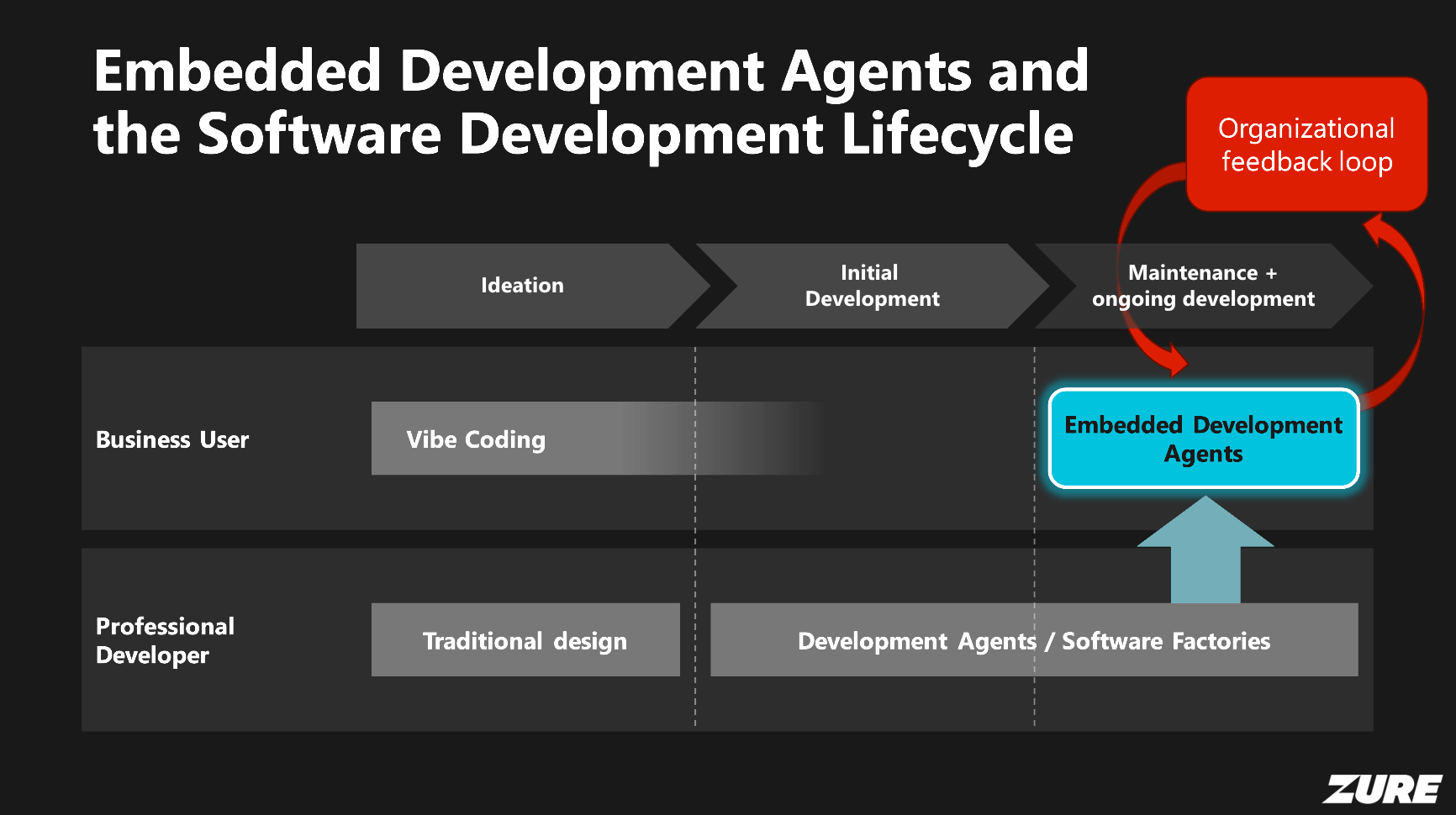
Embedded Development Agents and the Software Development Lifecycle.
What does working with an EDA feel like?
Let’s say you’re looking at a business system that contains a report, but that report is missing a filter you desperately need. With an EDA-enabled business system, you point at the place where you want the filter and type in your request (“Add the capability to filter this data by cost center”).
Within a couple of minutes, the agent analyzes your application and asks you to confirm the specification. For a simple filter, that’s very straightforward. Bigger changes, such as adding a field, raise more questions: In which user interface can that field be filled? Is it mandatory? What are its validation rules?
You answer them right there. Once you’re done, the agent adds a detailed implementation plan to your ticketing system, and in the background, a development agent sets off to implement the change. After a while, you receive a Teams message asking you to verify the change in a testing site just for you. You can either prompt for further changes, or you can approve it.
Once approved, the change is typically passed over to the dev team for validation. It would obviously also be possible to just deploy it right away, but for most serious business software, risk management requires a controlled deployment cadence run by the dev team.
Developers benefit too. Instead of fuzzy, incomplete bug reports, they receive working changes built by a development agent within their technical guardrails and architectural guidelines – and already validated by a business user. In cases where the result isn’t perfect, it’s more than we’ve ever had in the industry previously, so approval and deployment move faster.
Eating our own dogfood: EDAs at Zure
The concept of embedded development agents was born in our own work. Zure runs on custom software – a lot of it, as we’ve had 15 years to build it. As we grow and evolve, we need a continuous stream of changes: A CRM deal can now be implemented by multiple subsidiaries. Staffing reports need organizational permission filters. AI token usage needs to be allocated per customer to facilitate billing, and so on.
The first-ever EDA embedded in our internal ERP system is called “Craft Agent”. It has been hanging in the bottom right corner of the system for almost a year. It drives most of our feature development and helps with rollouts: if you don’t know how something works, just ask the agent. It’s always more up to date than any user manual, because it works directly on the app’s own source code and databases.
Craft Agent has given Zure a staggering rate of change. Most weeks, we push over 200 changes live. Validating all of them takes less than 10 hours of developer time a week, and the AI token cost of running Craft Agent is in low hundreds of euros per month.
We have been in the software development business for a long, long time, and have never seen productivity like this.
Accept cookies to view the video above where Jarno elaborates how Craft Agent has increased our agility.
What EDAs offer organizations
Most of the benefits come from moving routine work to a shorter, better-defined path:
- Shorter turnaround for small changes. Routine requests such as new fields, filters and wording changes can move from idea to review without waiting in a development backlog.
- A faster feedback loop. End user requests are captured in context, so developers learn what users are actually trying to do – not just what they typed into a ticket. Users see they’ve been heard, and fixes arrive quickly.
- Better use of developer time. Professional developers are still needed, but they can focus on architecture, integrations and complex functionality instead of a long tail of minor adjustments.
- Business users as contributors. The people who know the process best can shape their tools directly and see the result before it is released.
- Governance by design. Changes follow a structured process, the agent operates within defined limits, and developers own the release decision. This is a deliberate difference from vibe-coding platforms, where such controls are typically limited.
A shift in the role of custom software
Organizations have long faced a trade-off. Custom software fits the business precisely, but it is slow and costly to change. Off-the shelf SaaS products and low-code/vibe coded apps are easier to fine-tune, but less suited for business-critical end-to-end process requirements.
EDAs narrow this gap. A professionally built application is rapidly modifiable, without giving up the qualities that make it fit for production: a maintained codebase, code review, testing and controlled releases. That changes what custom software can be: not a project that is finished and then slowly ages, but a strategic investment that keeps improving for as long as the business depends on it.
We have proven the approach in our own internal tooling. The principles above come from that work: clear limits on what the agent may change, a straightforward review experience for the person who requested the change, and a release step driven by developers.
In a later blog post, we’ll also talk more about the tech pipeline and constraints of Embedded Development Agents.
We’re now making Embedded Development Agents available for our customers’ business applications. We’re starting with new applications, where the right governance can be built in from day one.
If you are responsible for business applications, we’d love to talk about whether an EDA would suit your environment and what it would take.
Zure is also present in the following events, so if you’re around, let’s talk!
- ESPC26, 30th November–3rd December 2026, Amsterdam
- Microsoft Frontier Transformation Day, 2nd December 2026, Helsinki
- Cloudbrew 2026, 10th–11th December 2026, Mechelen