

This is Part 3 of our BizTalk lifecycle series.
-
Part 1 covered Microsoft's lifecycle announcement,
-
Part 2 looked at when staying on BizTalk still makes sense, and when it's time to move on.
By now, one thing should be clear:
After the BizTalk lifecycle announcement, the question is no longer if you will move away from BizTalk, but how and when.
What often blocks organizations at this stage is not a lack of technology, but a lack of structure. Many teams know they need to modernize, yet struggle to compare options in an objective manner.
This article lays out the main migration options we see in practice and introduces a decision matrix to help you choose a path that fits your organization.
First of all: There is no “BizTalk replacement”
A critical mindset shift is required.
BizTalk is/was a single, all-in-one integration product.
Modern integration is a platform, composed of multiple services and patterns.
As a result:
- There is no one-size-fits-all replacement
- Different integration types may follow different paths
- Migration is usually incremental, not a big bang
With that in mind, let’s look at the realistic options.
The four migration options we see most often
Option 1 — Keep BizTalk and do nothing (short-term only)
What this means
- BizTalk continues to run unchanged
- No migration work starts yet
- Focus remains on operational stability
When it can make sense
- Very low change rate
- Heavy regulatory constraints
- BizTalk is supporting systems already planned for retirement
Risks
- No learning curve started
- Knowledge erosion continue
- Options narrow over time
As such, this option only works as a temporary holding pattern, not an actual strategy.
Option 2 — Coexistence (Side-by-side modernization)
What this means
- BizTalk remains operational
- A new integration platform is introduced next to it
- New integrations are built on the new platform
- Existing BizTalk flows migrate gradually
When it makes sense
- Large or complex landscapes
- Business continuity is critical
- You want to spread risk and cost over time
Trade-off
- Temporary complexity
- Requires clear governance to avoid duplication
This is the most common and most controlled approach we see.
Option 3 — Domain-by-domain migration
What this means
- Integrations are grouped by domain (e.g. Finance, Supply Chain, Sales)
- One domain migrates at a time
- BizTalk is gradually decommissioned
When it makes sense
- Clear domain ownership and boundaries
- Reasonable integration boundaries
- Business units can move independently
Trade-off
- Requires good domain modeling
- Some shared services need special attention
This option balances structure with progress.
Option 4 — Full replacement (Big Bang)
What this means
- BizTalk is replaced in a single program
- Fixed timeline
- Strong executive mandate
- New integrations are built on the new platform
When it makes sense
- Smaller integration landscape
- Strong funding and sponsorship
- Low tolerance for long coexistence
Risks
- High pressure
- Limited flexibility
- Very unforgiving if scope is underestimate
This option works, but only in very specific conditions.
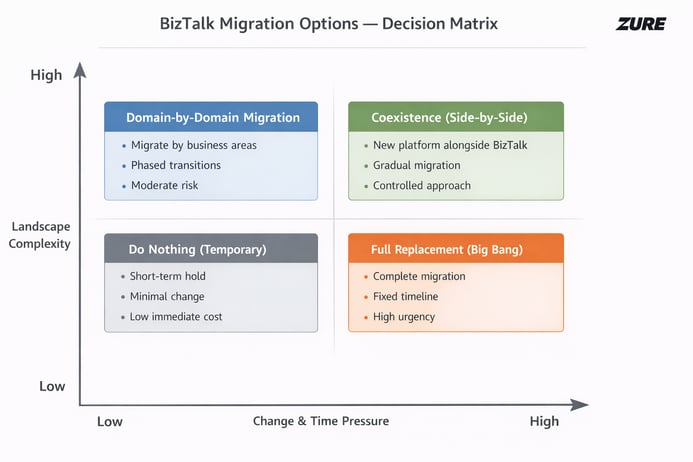
The decision matrix
The table below summarizes how to think about these options.
Common mistakes at this stage
Before moving on, a few patterns to avoid:
- Choosing a technology before choosing a strategy
- Treating all integrations as equal
- Underestimating coexistence governance
- Assuming “lift-and-shift” is faster (it rarely is)
- Waiting for a perfect future state before starting
Progress beats perfection.
What you should have after this article
At this point, you should be able to answer:
- Which options are clearly wrong for us?
- Which one or two options are realistically viable?
- What constraints (regulatory, organizational, budgetary) shape our choice?
If you cannot answer those questions yet, that’s normal — but it means the next step is necessary.
What comes next
In the next article, we'll get into how to actually build your migration strategy — including why "Logic Apps first" isn't always the right call, and how to think about sequencing once you've picked a path. We'll link it here as soon as it's live.
This is where the conversation shifts from options to architecture and decisions in technology need to be made.
Choosing a migration path is not about being fast.
It’s about being deliberate, while you still have options.